To amend the Internal Revenue Code of 1986 to permit certain population census tracts containing former military installations to be designated as qualified opportunity zones.
Sponsor
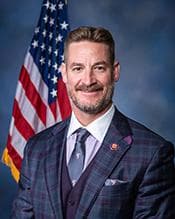
Full profile: /officials/S001214
Source: Congress.gov · FEC
Cosponsors (1)
Members who have signed on to support this bill since introduction. Source: Congress.gov.
Latest Action
The most recent step in the bill's legislative path. Committee Activity below shows referrals and reports; the full action-by-action history including floor proceedings lives at Congress.gov →
Committee Activity
Currently in
- House Committee on Ways and MeansReferred To · 2026-07-30
Plain-English Summary
The proposal would allow certain economically disadvantaged areas that contain closed military bases to be designated as "opportunity zones," which are special areas where investors get tax breaks for putting money into local businesses and real estate development. This would help communities around former military installations attract investment and create jobs by making it more financially attractive for businesses to invest there. The change would affect investors, local businesses, and residents in communities near decommissioned military bases.
AI-assisted summary generated from the official bill metadata (title, subjects, actions) sourced from Congress.gov. Cached and reviewed. Always verify against the official text linked below.
Full Bill Text
Verbatim text published on Congress.gov via GovInfo. Use Cmd+F / Ctrl+F to search within this excerpt.
[Congressional Bills 119th Congress] [From the U.S. Government Publishing Office] [H.R. 10006 Introduced in House (IH)] <DOC> 119th CONGRESS 2d Session H. R. 10006 To amend the Internal Revenue Code of 1986 to permit certain population census tracts containing former military installations to be designated as qualified opportunity zones. _______________________________________________________________________ IN THE HOUSE OF REPRESENTATIVES July 30, 2026 Mr. Steube (for himself and Mr. Thompson of California) introduced the following bill; which was referred to the Committee on Ways and Means _______________________________________________________________________ A BILL To amend the Internal Revenue Code of 1986 to permit certain population census tracts containing former military installations to be designated as qualified opportunity zones. Be it enacted by the Senate and House of Representatives of the United States of America in Congress assembled, SECTION 1. SHORT TITLE. This Act may be cited as the ``Increasing Opportunity For Reindustrialization Act''. SEC. 2. CERTAIN AREAS CONTAINING FORMER MILITARY INSTALLATIONS ELIGIBLE FOR DESIGNATION AS QUALIFIED OPPORTUNITY ZONES. (a) In General.--Section 1400Z-1(c)(1) of the Internal Revenue Code of 1986 is amended-- (1) by striking ``or'' at the end of subparagraph (A)(ii), (2) by striking the period at the end of subparagraph (B)(ii)(II), and (3) by adding at the end the following new subparagraph: ``(C) such population census tract contains any portion of a former installation, facility, or entity of the Department of Defense closed pursuant to a base realignment and closure round.''. (b) Designations Exempted From Limitation.--Section 1400Z-1(d) of the Internal Revenue Code of 1986 is amended by adding at the end the following new subparagraph: ``(3) Special rule for population census tracts containing former military installations.--For purposes of applying paragraphs (1) and (2)-- ``(A) a population census tract which is described in subsection (c)(1)(C) and which does not meet the requirements of subparagraph (A) or (B) of subsection (c)(1) shall not be treated as a low-income community, and ``(B) the number of population census tracts in a State that may be designated as qualified opportunity zones under this section during any period (determined after application of paragraphs (1) and (2)) shall be increased by the number of population census tracts described in subsection (c)(1)(C) and nominated for designation as qualified opportunity zones during such period.''. (c) Effective Date.--The amendments made by this subsection shall apply to areas designated under section 1400Z-1 of the Internal Revenue Code of 1986 after the date of the enactment of this Act. <all>
Related legislation
Bills by the same sponsor or covering overlapping subjects.
- HRES1411Providing for consideration of the bill (H.R. 2162) to provide for the protection of the integrity of honey marketed in the United States, and for other purposes.Referred to Committee · 2026-07-22
- HR9767Craft Distilled Spirits Direct-to-Consumer Shipping Act of 2026Referred to Committee · 2026-07-16
- HRES1431Impeaching John Edwin Steele, Senior District Judge for the United States District Court for the Middle District of Florida, for high crimes and misdemeanors.Referred to Committee · 2026-07-15
- HR9662Birthright CLAIM Act of 2026Referred to Committee · 2026-07-14