HR10152Referred to Committee
Open-Source AI Leadership Act
Introduced
In Committee
3
Passed One Chamber4
Passed Both5
Signed into Law119th
Congress
2026-08-27
Introduced
0
Cosponsors
HR
ⓘType
Sponsor
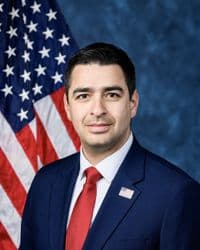
Gabe Evans
Republican · CO · Representative
Votes with party: 97.0% (642 recorded votes)
Top industries funding sponsor:
- Veterans$3,500k
- Tech & Internet$86k
Full profile: /officials/E000300
Source: Congress.gov · FEC
Cosponsors (0)
Members who have signed on to support this bill since introduction. Source: Congress.gov.
No cosponsors on record. Bills can pass without cosponsors — this often means the sponsor introduced the bill alone, either because it's a messaging bill, a chairman's mark, or simply early in the legislative cycle.
Latest Action
The most recent step in the bill's legislative path. Committee Activity below shows referrals and reports; the full action-by-action history including floor proceedings lives at Congress.gov →
Committee Activity
Currently in
- House Committee on Energy and CommerceReferred To · 2026-08-27
Plain-English Summary
Plain-English summary pending. Introduced on 2026-08-27. Check back soon — summaries are generated as bills progress through Congress.
Full Bill Text
Verbatim text published on Congress.gov via GovInfo. Use Cmd+F / Ctrl+F to search within this excerpt.
[Congressional Bills 119th Congress] [From the U.S. Government Publishing Office] [H.R. 10152 Introduced in House (IH)] <DOC> 119th CONGRESS 2d Session H. R. 10152 To direct the Secretary of Commerce to support the adoption and use of American open artificial intelligence models, and for other purposes. _______________________________________________________________________ IN THE HOUSE OF REPRESENTATIVES August 27, 2026 Mr. Evans of Colorado introduced the following bill; which was referred to the Committee on Energy and Commerce _______________________________________________________________________ A BILL To direct the Secretary of Commerce to support the adoption and use of American open artificial intelligence models, and for other purposes. Be it enacted by the Senate and House of Representatives of the United States of America in Congress assembled, SECTION 1. SHORT TITLE. This Act may be cited as the ``Open-Source AI Leadership Act''. SEC. 2. ADOPTION AND USE OF QUALIFIED OPEN MODELS. The Secretary shall take any of the following actions as appropriate to support the adoption and use of qualified open models in interstate and foreign commerce: (1) Designate a single point of contact to coordinate any effort between the Department of Commerce, any relevant private sector entity, and any other relevant stakeholder to support the adoption and use of qualified open models. (2) Review any relevant program or power of the Secretary related to the adoption and use of qualified open models and direct the head of any such program, as appropriate, to support such adoption and use. (3) Identify any barrier to the adoption and use of qualified open models and take any action as appropriate to address any such barrier. (4) Enter into agreements, as appropriate, to support the adoption and use of qualified open models with any of the following: (A) A private sector entity, including a startup. (B) An agency. (C) A State. (D) A qualified foreign partner. (5) Develop policy and recommendations to facilitate the adoption and use of qualified open models. (6) Identify any relevant evidence-based approach, best practice, framework, benchmark, or other method, as appropriate, to monitor the adoption and use of qualified open models and foreign adversary models. SEC. 3. ASSESSMENT OF FOREIGN ADVERSARY MODELS. (a) In General.--The Secretary shall identify, assess, and make publicly known, as appropriate, any risk related to the adoption and use of foreign adversary models, including any risk related to the following: (1) The training of a foreign adversary model, including any risk related to a covered nation, or an entity or individual that is subject to the control of a covered nation, conducting any such training through any unauthorized use of an artificial intelligence model. (2) The confidentiality, integrity, and accessibility of personal and proprietary information, including any risk of access to such information by a covered nation or an entity or individual that is subject to the control of a covered nation. (3) The security and resiliency of any organization that uses or adopts a foreign adversary model and any risk that may result to the supply chain of such organization as a result of any such use or adoption. (4) Any output of a foreign adversary model, including with respect to historical accuracy, scientific inquiry, and freedom of expression. (5) The efficacy, or lack thereof, of any feature of a foreign adversary model intended to prevent misuse or exploitation of such model, including any safety or security feature intended to prevent any such misuse or exploitation. (6) The development and use of chemical, biological, radiological, or nuclear capabilities, or any other similar risk related to the national security and economic security of the United States. (b) Publication.--Not later than 18 months after the…
Show the remaining 563 wordsHide the remaining 563 words
date of the enactment of this Act, and annually thereafter, the Secretary shall publish on a publicly facing website a report that assesses any risk related to a foreign adversary model identified and assessed under subsection (a) and information relating to the following: (1) An overview of the adoption and use of leading foreign adversary models. (2) The cost, capability, and performance of foreign adversary models. (3) A comparison between the information required by paragraphs (1) and (2) relating to foreign adversary models and such information, as available, relating to qualified open models. (c) Report to Congress.--Not later than 30 days after the publication of a report under subsection (b), the Secretary shall submit to the Committee on Energy and Commerce of the House of Representatives and the Committee on Commerce, Science, and Transportation of the Senate the report. (d) Sunset.--The requirement described in subsection (b) does not apply beginning on the date that is 10 years after the date of the enactment of this Act. SEC. 4. RULE OF CONSTRUCTION. Nothing in this Act may be construed to authorize the Secretary to ban, restrict, or otherwise make unavailable an open artificial intelligence model in interstate or foreign commerce. SEC. 5. DEFINITIONS. In this Act: (1) Agency.--The term ``agency'' has the meaning given that term in section 551 of title 5, United States Code. (2) Artificial intelligence.--The term ``artificial intelligence'' has the meaning given that term in section 5002 of the National Artificial Intelligence Initiative Act of 2020 (15 U.S.C. 9401). (3) Artificial intelligence model.--The term ``artificial intelligence model'' means a software component of an information system that incorporates artificial intelligence and uses computational, statistical, or machine-learning techniques to produce outputs from a defined set of inputs. (4) Covered nation.--The term ``covered nation'' has the meaning given that term in section 4872(f) of title 10, United States Code. (5) Foreign adversary model.--The term ``foreign adversary model'' means an open artificial intelligence model that is developed or made available in interstate or foreign commerce by-- (A) a covered nation; or (B) an entity or individual that is subject to the control of a covered nation. (6) Open artificial intelligence model.--The term ``open artificial intelligence model'' means an artificial intelligence model-- (A) with model weights that are publicly released for download or distribution; or (B) that is distributed under an open license that permits use, modification, and redistribution of the source code and model weights of the model. (7) Qualified foreign partner.--The term ``qualified foreign partner'' means a foreign country or foreign political and economic union that is not a covered nation. (8) Qualified open model.--The term ``qualified open model'' means an open artificial intelligence model that is-- (A) developed and made available by a U.S. person in interstate or foreign commerce; and (B) not developed or made available by-- (i) a covered nation; or (ii) an entity or individual that is subject to the control of a covered nation. (9) Secretary.--The term ``Secretary'' means the Secretary of Commerce. (10) State.--The term ``State'' means each State of the United States, the District of Columbia, each commonwealth, territory, or possession of the United States, and each federally recognized Indian Tribe. (11) U.S. person.--The term ``U.S. person'' means a person that-- (A) is domiciled in the United States; (B) is headquartered in the United States; and (C) is organized under the laws of the United States. <all>
Related legislation
Bills by the same sponsor or covering overlapping subjects.
- HR8005Stop Pills That Kill ActReferred to Committee · 2026-07-21
- HR9340Ratepayer Protection ActReferred to Committee · 2026-07-21
- HR7574ELO Realignment and Strategic Engagement Reform Act of 2026Passed House · 2026-07-14
- HR7764National Threat Evaluation and Reporting Program Reassignment and Funding Reform Act of 2026Referred to Committee · 2026-05-14