HR10712Referred to Committee
First Responder Behavioral Health Access Act
Introduced
In Committee
3
Passed One Chamber4
Passed Both5
Signed into Law119th
Congress
2026-10-01
Introduced
1
Cosponsors
HR
ⓘType
Sponsor
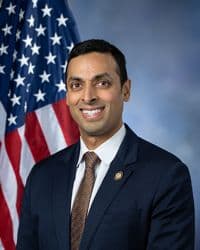
Suhas Subramanyam
Democrat · VA · Representative
Votes with party: 96.2% (666 recorded votes)
Top industries funding sponsor:
- Climate & Environment$106k
Full profile: /officials/S001230
Source: Congress.gov · FEC
Cosponsors (1)
Members who have signed on to support this bill since introduction. Source: Congress.gov.
Latest Action
The most recent step in the bill's legislative path. Committee Activity below shows referrals and reports; the full action-by-action history including floor proceedings lives at Congress.gov →
Committee Activity
Currently in
- House Committee on Energy and CommerceReferred To · 2026-10-01
Plain-English Summary
Plain-English summary pending. Introduced on 2026-10-01. Check back soon — summaries are generated as bills progress through Congress.
Full Bill Text
Verbatim text published on Congress.gov via GovInfo. Use Cmd+F / Ctrl+F to search within this excerpt.
[Congressional Bills 119th Congress] [From the U.S. Government Publishing Office] [H.R. 10712 Introduced in House (IH)] <DOC> 119th CONGRESS 2d Session H. R. 10712 To amend the Public Health Service Act to include certain emergency response providers as eligible institutions under mental and behavioral health education and training grant program, and for other purposes. _______________________________________________________________________ IN THE HOUSE OF REPRESENTATIVES October 1, 2026 Mr. Subramanyam (for himself and Mr. Rutherford) introduced the following bill; which was referred to the Committee on Energy and Commerce _______________________________________________________________________ A BILL To amend the Public Health Service Act to include certain emergency response providers as eligible institutions under mental and behavioral health education and training grant program, and for other purposes. Be it enacted by the Senate and House of Representatives of the United States of America in Congress assembled, SECTION 1. SHORT TITLE. This Act may be cited as the ``First Responder Behavioral Health Access Act''. SEC. 2. INCLUDING CERTAIN EMERGENCY RESPONSE PROVIDERS AS ELIGIBLE INSTITUTIONS UNDER MENTAL AND BEHAVIORAL HEALTH EDUCATION AND TRAINING PROGRAM. Section 756 of the Public Health Service Act (42 U.S.C. 294e-1) is amended-- (1) in subsection (a), in the matter preceding paragraph (1), by striking ``of the students'' and inserting ``of the students, and in the case of an eligible institution that is a qualified emergency response provider, to support the field placement and recruitment of clinicians or behavioral health service providers in qualified emergency response providers,''; (2) by redesignating subsection (f) as subsection (g); and (3) by inserting after subsection (e) the following: ``(f) Definitions.--In this section: ``(1) Eligible institution.--The term `eligible institution' includes a qualified emergency response provider. ``(2) Public safety telecommunicator.--The term `public safety telecommunicator' means a public safety telecommunicator as designated in detailed occupation 43-5031 in the Standard Occupational Classification Manual of the Office of Management and Budget issued in 2018, or any successor designation. ``(3) Qualified emergency response provider.--The term `qualified emergency response provider' means-- ``(A) an emergency response provider (as defined in section 2 of the Homeland Security Act of 2002 (6 U.S.C. 101)); and ``(B) a public safety telecommunicator.''. SEC. 3. PILOT PROGRAM SUPPORTING BEHAVIORAL HEALTH OF FIRST RESPONDERS. (a) In General.--The Secretary of Health and Human Services (in this section referred to as the ``Secretary'') shall establish a 3-year pilot program under which the Secretary will award grants to eligible entities to assist qualified emergency response providers in supporting the behavioral health needs of qualified emergency response providers. (b) Use of Funds.--An eligible entity receiving a grant under this section may use funds received through the grant for one of the following purposes: (1) Embedding clinicians, who are licensed or certified by the respective jurisdictions in which such clinicians practice, with qualified emergency response providers for purposes of providing confidential counseling services, in accordance with confidentiality requirements of such respective jurisdiction. (2) Establishing a peer-to-peer program at a qualified emergency response provider under which counseling services described in paragraph (1) are provided, including in response to a behavioral health incident and at periodic intervals after such an incident. (3) Overseeing the operation of, or otherwise supporting, such a program. (4) Assisting in providing training to peer-to-peer behavioral health care providers at a qualified emergency response provider. (c) Application.--An eligible entity seeking a grant under this section shall submit an application at such time and in such manner as the Secretary may require. Such application shall include-- (1) a description of how the entity plans to use funds received through the grant; (2) a description of any behavioral health care programs the entity operates as of the date of the submission…
Show the remaining 301 wordsHide the remaining 301 words
of the application, including any peer-to-peer programs; and (3) the entity's assessment of how the grant funds could be used to improve behavioral health outcomes in the area served by such entity. (d) Priority.--In awarding grants under this section, the Secretary shall give priority to eligible entities seeking to assist qualified emergency response providers that are under-resourced with respect to behavioral health care and peer-to-peer programs. (e) Geographic Distribution.--In awarding grants under this section, the Secretary shall ensure an equitable geographic distribution of funds. (f) Report.--Not later than one year after the date on which the pilot program under this section concludes, the Secretary shall submit to Congress a report on such program. Such report shall address-- (1) whether and how the program improved behavioral health outcomes for qualified emergency response providers; (2) how many peer-to-peer contacts were made under the program; and (3) how many peer-to-peer behavior health care providers were trained under the program. (g) Definitions.--In this section: (1) Eligible entity.--The term ``eligible entity'' means a State, local, county, or regional public health department, a local, county, or regional behavioral health agency, or a non- profit organization with experience servicing first responders with respect to improving behavioral health outcomes. (2) Public safety telecommunicator.--The term ``public safety telecommunicator'' means a public safety telecommunicator as designated in detailed occupation 43-5031 in the Standard Occupational Classification Manual of the Office of Management and Budget issued in 2018, or any successor designation. (3) Qualified emergency response provider.--The term ``qualified emergency response provider'' means-- (A) an emergency response provider (as defined in section 2 of the Homeland Security Act of 2002 (6 U.S.C. 101)); and (B) a public safety telecommunicator. (h) Authorization of Appropriations.--There are authorized to be appropriated to carry out this Act $10,000,000 for each of fiscal years 2027 through 2029. <all>
Related legislation
Bills by the same sponsor or covering overlapping subjects.
- HR10711Reducing Visa Delays ActReferred to Committee · 2026-10-01
- HR10713Federal Telework Protection ActReferred to Committee · 2026-10-01
- HR10715Domestic Visa Renewal Modernization ActReferred to Committee · 2026-10-01
- HR10714Strengthening Emergency Responses ActReferred to Committee · 2026-10-01