HR2978Referred to Committee
GUARD Act
Introduced
In Committee
3
Passed One Chamber4
Passed Both5
Signed into Law119th
Congress
2025-04-21
Introduced
54
Cosponsors
HR
ⓘType
Sponsor
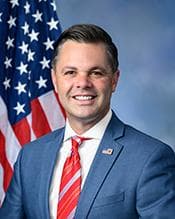
Zachary Nunn
Republican · IA · Representative
Votes with party: 96.2% (624 recorded votes)
Full profile: /officials/N000193
Source: Congress.gov · FEC
Cosponsors (54)
Members who have signed on to support this bill since introduction. Source: Congress.gov.
- Josh Gottheimer (D-NJ-5)Original· 2025-04-21
- Scott Fitzgerald (R-WI-5)Original· 2025-04-21
- Troy E. Nehls (R-TX-22)· 2025-08-01
- Jefferson Shreve (R-IN-6)· 2025-09-15
- Barry Moore (R-AL-1)· 2025-09-26
- Daniel Meuser (R-PA-9)· 2025-09-26
- Roger Williams (R-TX-25)· 2025-09-26
- Sarah McBride (D-DE)· 2025-09-26
- Laura Gillen (D-NY-4)· 2025-10-14
- Josh Harder (D-CA-9)· 2025-10-24
- Eric Sorensen (D-IL-17)· 2025-11-17
- Julia Brownley (D-CA-26)· 2025-11-17
- Andy Barr (R-KY-6)· 2025-11-18
- Glenn Grothman (R-WI-6)· 2025-11-19
- John W. Mannion (D-NY-22)· 2025-12-09
- Maria Elvira Salazar (R-FL-27)· 2025-12-09
- George Whitesides (D-CA-27)· 2025-12-17
- Thomas R. Suozzi (D-NY-3)· 2025-12-17
- Derek Tran (D-CA-45)· 2025-12-18
- Gabe Vasquez (D-NM-2)· 2025-12-18
- David G. Valadao (R-CA-22)· 2026-02-10
- Robert J. Wittman (R-VA-1)· 2026-02-10
- Jefferson Van Drew (D-NJ-2)· 2026-02-20
- Jahana Hayes (D-CT-5)· 2026-02-23
- Susie Lee (D-NV-3)· 2026-02-23
- Tim Moore (R-NC-14)· 2026-02-23
- Troy Downing (R-MT-2)· 2026-02-23
- Marlin A. Stutzman (R-IN-3)· 2026-02-24
- Thomas P. Tiffany (R-WI-7)· 2026-02-24
- Michael Lawler (R-NY-17)· 2026-03-18
- Adam Smith (D-WA-9)· 2026-04-14
- Jennifer A. Kiggans (R-VA-2)· 2026-04-15
- Tracey Mann (R-KS-1)· 2026-04-21
- Angie Craig (D-MN-2)· 2026-04-22
- Julie Johnson (D-TX-32)· 2026-04-22
- Monica De La Cruz (R-TX-15)· 2026-04-23
- Suhas Subramanyam (D-VA-10)· 2026-04-23
- Ashley Hinson (R-IA-2)· 2026-05-11
- Julie Fedorchak (R-ND)· 2026-05-12
- Sean Casten (D-IL-6)· 2026-05-12
- George Latimer (D-NY-16)· 2026-05-13
- Ken Calvert (R-CA-41)· 2026-05-14
- Young Kim (R-CA-40)· 2026-05-14
- August Pfluger (R-TX-11)· 2026-05-19
- Timothy M. Kennedy (D-NY-26)· 2026-05-19
- Derek Schmidt (R-KS-2)· 2026-06-02
- Glenn Ivey (D-MD-4)· 2026-06-02
- Gabe Evans (R-CO-8)· 2026-06-03
- Gary J. Palmer (R-AL-6)· 2026-06-03
- Gabe Amo (D-RI-1)· 2026-06-04
- Burgess Owens (R-UT-4)· 2026-06-10
Latest Action
The most recent step in the bill's legislative path. Committee Activity below shows referrals and reports; the full action-by-action history including floor proceedings lives at Congress.gov →
At the conclusion of debate, the Yeas and Nays were demanded and ordered. Pursuant to the provisions of clause 8, rule XX, the Chair announced that further proceedings on the motion would be postponed.
2026-09-14
Source: Congress.gov
Committee Activity
Currently in
- House Committee on Financial ServicesReported By · 2026-06-24
- House Committee on the JudiciaryReferred To · 2025-04-21
Previously
- House Committee on Financial ServicesMarkup By · 2026-05-13
- Judiciary CommitteeReferred To · 2025-04-21
- House Committee on Financial ServicesReferred To · 2025-04-21
- Financial Services CommitteeReferred To · 2025-04-21
Plain-English Summary
Guarding Unprotected Aging Retirees from Deception Act of 2026 or the GUARD Act of 2026 This bill allows state, local, and tribal law enforcement agencies and grantees that receive funds from certain law enforcement grant programs to use the funds to investigate general financial fraud, elder financial fraud, and pig butchering. Pig butchering refers to a confidence and investment fraud in which a victim is gradually lured into transferring increasing amounts of money, generally in the form of cryptocurrency, into a fake virtual investment. The bill allows federal law enforcement agencies to assist state, local, and tribal law enforcement agencies and fusion centers in the use of tracing tools for blockchain and related technology tools. Finally, the bill requires the Financial Crimes Enforcement Network (FinCEN) to report on efforts to combat general financial fraud, elder financial fraud, pig butchering, and scams, including an evaluation of any legislative recommendations to improve the efforts. The bill also requires FinCEN to report on the state of general financial fraud, elder financial fraud, pig butchering, and scams in the United States, including trends in the crimes.
Plain-English rewrite of the Congressional Research Service summary published on Congress.gov. Cached and reviewed.
Subjects
Crime and Law Enforcement
Full Bill Text
Verbatim text published on Congress.gov via GovInfo. Use Cmd+F / Ctrl+F to search within this excerpt.
[Congressional Bills 119th Congress] [From the U.S. Government Publishing Office] [H.R. 2978 Introduced in House (IH)] <DOC> 119th CONGRESS 1st Session H. R. 2978 To permit State, local, and Tribal law enforcement agencies that receive eligible Federal grant funds to use such funds for investigating elder financial fraud, pig butchering, and general financial fraud, and to clarify that Federal law enforcement agencies may assist State, local, and Tribal law enforcement agencies in the use of tracing tools for blockchain and related technology, and for other purposes. _______________________________________________________________________ IN THE HOUSE OF REPRESENTATIVES April 21, 2025 Mr. Nunn of Iowa (for himself, Mr. Gottheimer, and Mr. Fitzgerald) introduced the following bill; which was referred to the Committee on the Judiciary, and in addition to the Committee on Financial Services, for a period to be subsequently determined by the Speaker, in each case for consideration of such provisions as fall within the jurisdiction of the committee concerned _______________________________________________________________________ A BILL To permit State, local, and Tribal law enforcement agencies that receive eligible Federal grant funds to use such funds for investigating elder financial fraud, pig butchering, and general financial fraud, and to clarify that Federal law enforcement agencies may assist State, local, and Tribal law enforcement agencies in the use of tracing tools for blockchain and related technology, and for other purposes. Be it enacted by the Senate and House of Representatives of the United States of America in Congress assembled, SECTION 1. SHORT TITLE. This Act may be cited as the ``Guarding Unprotected Aging Retirees from Deception Act'' or the ``GUARD Act''. SEC. 2. DEFINITIONS. In this Act: (1) Elder financial fraud.--The term ``elder financial fraud'' means the illegal or improper use of an elderly or adult with a disability's money, property, or other resources for monetary or personal benefit, profit, or gain. (2) Eligible federal grant funds.--The term ``eligible Federal grant funds'' means funds received under the following: (A) The Department of Justice Economic, High- Technology, White Collar, and Internet Crime Prevention National Training and Technical Assistance Program. (B) The Department of Justice Information Sharing Training and Technical Assistance Program. (C) The Department of Justice Internet of Things National Training and Technical Assistance Program. (D) Section 1401 of the Violence Against Women Act Reauthorization Act of 2022 (34 U.S.C. 30107; relating to Local Law Enforcement Grants for Enforcement of Cybercrimes Against Individuals). (E) The Department of Justice COPS Technology and Equipment Program. (3) General financial fraud.--The term ``general financial fraud'' means the intentional misrepresentation of information or identity to deceive others, the unlawful use of a credit card, debit card, or automated teller machine or the use of electronic means to transmit deceptive information, in order to obtain money or other things of value. (4) Pig butchering.--The term ``pig butchering'' means a confidence and investment fraud in which the victim is gradually lured into making increasing monetary contributions, generally in the form of cryptocurrency, to a seemingly sound investment before the scammer disappears with the contributed monies. (5) Scam.--The term ``scam'' means a financial crime undertaken through the use of social engineering that uses deceptive inducement to acquire-- (A) authorized access to funds; or (B) personal or sensitive information that can facilitate the theft of financial assets. (6) State.--The term ``State'' means each of the several States, the District of Columbia, and each territory of the United States. SEC. 3. FEDERAL GRANTS USED FOR INVESTIGATING ELDER FINANCIAL FRAUD, PIG BUTCHERING, AND GENERAL FINANCIAL FRAUD. (a) In General.--State, local, and Tribal law enforcement agencies that receive eligible Federal grant funds may use such funds for investigating elder financial fraud, pig butchering,…
Show the remaining 1,005 wordsHide the remaining 1,005 words
and general financial fraud, including by-- (1) hiring and retaining analysts, agents, experts, and other personnel; (2) providing training specific to complex financial investigations, including training on-- (A) coordination and collaboration between State, local, Tribal, and Federal law enforcement agencies; (B) assisting victims of financial fraud and exploitation; (C) the use of blockchain intelligence tools and related capabilities related to emerging technologies identified in the February 2024 ``Critical and Emerging Technology List Update'' of the Fast Track Action Subcommittee on Critical and Emerging Technologies of the National Science and Technology Council (the ``Critical and Emerging Technology List''); and (D) unique aspects of fraud investigations, including transnational financial investigations and emerging technologies identified in the Critical and Emerging Technology List; (3) obtaining software and technical tools to conduct financial fraud and exploitation investigations; (4) encouraging improved data collection and reporting; (5) supporting training and tabletop exercises to enhance coordination and communication between financial institutions and State, local, Tribal and Federal law enforcement agencies for the purpose of stopping fraud and scams; and (6) designating a financial sector liaison to serve as a point of contact for financial institutions to share and exchange with State, local, Tribal and Federal law enforcement agencies information relevant to the investigation of fraud and scams. (b) Report to Grant Provider.--Each law enforcement agency that makes use of eligible Federal grant funds for a purpose specified under subsection (a) shall, not later than 1 year after making such use of the funds, issue a report to the Federal agency that provided the eligible Federal grant funds, containing-- (1) an explanation of the amount of funds so used, and the specific purpose for which the funds were used; (2) statistics with respect to elder financial fraud, pig butchering, and general financial fraud in the jurisdiction of the law enforcement agency, along with an analysis of how the use of the funds for a purpose specified under subsection (a) affected such statistics; and (3) an assessment of the ability of the law enforcement agency to deter elder financial fraud, pig butchering, and general financial fraud. SEC. 4. REPORT ON GENERAL FINANCIAL FRAUD, PIG BUTCHERING, AND ELDER FINANCIAL FRAUD. No later than a year after the date of the enactment of this Act, the Secretary of the Treasury and the Director of the Financial Crimes Enforcement Network in consultation with the Attorney General, the Secretary of Homeland Security, and the appropriate Federal banking agencies and Federal functional regulators shall, jointly, submit to Congress a report on efforts and recommendations related to general financial fraud, pig butchering, elder financial fraud, and scams. SEC. 5. REPORT ON THE STATE OF SCAMS IN THE UNITED STATES. (a) In General.--Not later than 2 years after the date of the enactment of this Act, the Secretary of the Treasury and the Director of the Financial Crimes Enforcement Network in consultation with the Attorney General, the Secretary of Homeland Security, and the appropriate Federal banking agencies and Federal functional regulators shall submit a report to the Congress on the state of scams in the United States that-- (1) estimates-- (A) the number of financial fraud, pig butchering, elder financial fraud, and scams committed against American consumers each year, including-- (i) attempted scams, including through social media, online dating services, email, impersonation of financial institutions and non-bank financial institutions; (ii) successful scams, including through social media, online dating services, email, impersonation of financial institutions and non-bank financial institutions; (B) the number of consumers each year that lose money to one or more scams; (C) the dollar amount of consumer losses to scams each year; (D) the percentage of scams each year that can be attributed to-- (i) overseas actors; and (ii) organized crime; (E) the number of attempted scams each year that involve the impersonation of phone numbers associated with financial institutions and non-bank financial institutions; (F) an estimate of the number of synthetic identities impersonating American consumers each year; (2) provides an overview of the Federal civil and criminal enforcement actions brought against the recipients of the proceeds of financial fraud, pig butchering, elder financial fraud, and scams in the period covered by the report that includes-- (A) the number of such enforcement actions; (B) an evaluation of the effectiveness of such enforcement actions; (C) an identification of the types of claims brought against the recipients the recipients of the proceeds of financial fraud, pig butchering, elder financial fraud, and scams; (D) an identification of the types of penalties imposed through such enforcement actions; (E) an identification of the types of relief obtained through such enforcement actions; and (F) the number of such enforcement actions that are connected to a Suspicious Activity Report; and (3) identifies amounts made available and amounts expended to address financial fraud, pig butchering, elder financial fraud, and scams during the period covered by the report by-- (A) the Bureau of Consumer Financial Protection; (B) the Department of Justice; (C) the Federal Bureau of Investigation; (D) the Federal Communications Commission; (E) the Board of Governors of the Federal Reserve Board; (F) the Federal Trade Commission; (G) the Financial Crimes Enforcement Network; (H) the Securities and Exchange Commission; and (I) the Social Security Administration. (b) Solicitation of Public Comment.--In carrying out the report required under subsection (a), the Secretary of the Treasury shall solicit comments from consumers, social media companies, email providers, telecommunications companies, financial institutions, non- bank financial institutions. SEC. 6. REPORT TO CONGRESS. Each Federal agency that provides eligible Federal grant funds that are used for a purpose specified under section 3(a) shall issue an annual report to the Committee on Financial Services of the House of Representatives and the Committee on Banking, Housing, and Urban Affairs of the Senate containing the information received from law enforcement agencies under section 3(b). SEC. 7. FEDERAL LAW ENFORCEMENT AGENCIES ASSISTING STATE, LOCAL, AND TRIBAL LAW ENFORCEMENT AND FUSION CENTERS. Federal law enforcement agencies may assist State, local, and Tribal law enforcement agencies and fusion centers in the use of tracing tools for blockchain and related technology tools. <all>
Related legislation
Bills by the same sponsor or covering overlapping subjects.
- HR10283Congressional Pension Accountability ActReferred to Committee · 2026-09-03
- HR10234CLEAR Forms ActReferred to Committee · 2026-09-02
- HR7187Clarity for Compensation ActReferred to Committee · 2026-09-01
- HR9686FARM AI Act of 2026Referred to Committee · 2026-07-14