HR9372Referred to Committee
Data Infrastructure Energy Measurement and Standards Act
Introduced
In Committee
3
Passed One Chamber4
Passed Both5
Signed into Law119th
Congress
2026-06-18
Introduced
2
Cosponsors
HR
ⓘType
Sponsor
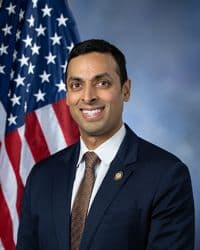
Suhas Subramanyam
Democrat · VA · Representative
Votes with party: 96.4% (580 recorded votes)
Top industries funding sponsor:
- Climate & Environment$106k
Full profile: /officials/S001230
Source: Congress.gov · FEC
Cosponsors (2)
Members who have signed on to support this bill since introduction. Source: Congress.gov.
Latest Action
The most recent step in the bill's legislative path. Committee Activity below shows referrals and reports; the full action-by-action history including floor proceedings lives at Congress.gov →
Committee Activity
Currently in
- House Committee on Science, Space, and TechnologyReferred To · 2026-06-18
Plain-English Summary
The federal government would require the National Institute of Standards and Technology to create guidelines for how data centers measure their energy consumption and to research ways to better predict future energy demands in the tech industry. This would help data centers operate more efficiently and give energy planners better information about how much power will be needed in the future. The effort primarily affects large technology companies that operate data centers and energy utilities that supply power to them.
AI-assisted summary generated from the official bill metadata (title, subjects, actions) sourced from Congress.gov. Cached and reviewed. Always verify against the official text linked below.
Full Bill Text
Verbatim text published on Congress.gov via GovInfo. Use Cmd+F / Ctrl+F to search within this excerpt.
[Congressional Bills 119th Congress] [From the U.S. Government Publishing Office] [H.R. 9372 Introduced in House (IH)] <DOC> 119th CONGRESS 2d Session H. R. 9372 To direct the Director of the National Institute of Standards and Technology to develop best practices for measuring data center energy use, study data availability for the purpose of improving energy demand forecasting capabilities, and for other purposes. _______________________________________________________________________ IN THE HOUSE OF REPRESENTATIVES June 18, 2026 Mr. Subramanyam (for himself, Mr. Obernolte, and Mrs. Foushee) introduced the following bill; which was referred to the Committee on Science, Space, and Technology _______________________________________________________________________ A BILL To direct the Director of the National Institute of Standards and Technology to develop best practices for measuring data center energy use, study data availability for the purpose of improving energy demand forecasting capabilities, and for other purposes. Be it enacted by the Senate and House of Representatives of the United States of America in Congress assembled, SECTION 1. SHORT TITLE. This Act may be cited as the ``Data Infrastructure Energy Measurement and Standards Act''. SEC. 2. ACTIVITIES TO SUPPORT METROLOGY OF DATA CENTER ENERGY USE. (a) Best Practices for Measuring Data Center Energy Use.--The Director of the National Institute of Standards and Technology, in consultation with the Secretary of Energy, shall carry out a measurement research program (in this section referred to as the ``program'') to inform the development or improvement of best practices, definitions, methodologies, procedures, and technical standards for the measurement of energy and water use by data centers and the workloads of such centers, including the measurement of energy and water use resulting from training and inference of artificial intelligence models or other compute intensive information processes. (b) Activities.--In carrying out the program, the Director shall carry out the following: (1) Conduct research and testing to improve the accuracy, efficacy, timeliness, and reliability of the measurement of energy and water use by data centers and the workloads of such centers. (2) Develop or identify best practices, guidelines, definitions, methodologies, and procedures for measuring and reporting energy and water use by data centers and the workloads of such centers, taking into consideration the following: (A) The type of workload and aggregate energy and water use by a given data center, including complex artificial intelligence workloads. (B) Temporal power consumption load profiles associated with data center energy use accounting for behind-the-meter generation, front-of-meter generation, and energy generation not provided to the electric grid on a facility-level basis. (C) Varying information technology system, power chain, and cooling configurations, including consideration of servers, storage, network, power transformation, distribution, and uninterruptible supply technologies. (D) Temporal variations in electricity loads due to variations in workloads, technology configurations, and data center locations, including local climate and resource factors. (3) Study data needs for relevant research and energy and water demand forecasting, and relevant driving factors relating to such needs, including an identification of the following: (A) Existing gaps in the following: (i) Data collection. (ii) Data availability from public and non- public sources. (iii) Researcher access. (B) Risks related to the gaps identified in clauses (i) through (iii) of subparagraph (A), including the reliability of energy and water demand forecasts from different stakeholder perspectives. (4) Support the development of standardized metrics and data sharing mechanisms that would help provide information to researchers and relevant stakeholders regarding data center energy and water use in such a way that promotes improved energy and water demand forecasting capabilities. (5) Coordinate with the Secretary of Energy to carry out the following: (A) Ensure applicable metrics and data are managed, stewarded, and archived appropriately, and in accordance with the best…
Show the remaining 386 wordsHide the remaining 386 words
practices described in paragraph (2). (B) Promote full and open exchange of such metrics and data at Federal and State levels, and with academia, industry, and other users, as practicable and appropriate. (6) Coordinate with international partners, including international standards organizations, to maintain global data center energy measurement standards. (c) Stakeholder Engagement.--In carrying out subsection (b), the Director shall seek to engage with and convene representatives of industry, academia, nonprofit organizations, standards development organizations, civil society groups, and appropriate Federal departments and agencies. (d) Briefings.--Not later than one year after the date of the enactment of this Act, and again not later than two years after such date, the Director shall brief the Committee on Science, Space, and Technology of the House of Representatives and the Committee on Commerce, Science, and Transportation and the Committee on Energy and Natural Resources of the Senate on the program. (e) Authorization of Appropriations.--There are authorized to be appropriated to the Director to carry out this section $10,000,000 for each of fiscal years 2027 through 2029. (f) Definitions.--In this section: (1) Artificial intelligence.--The term ``artificial intelligence'' has the meaning given such term in section 5002 of the National Artificial Intelligence Initiative Act of 2020 (15 U.S.C. 9401). (2) Artificial intelligence model.--The term ``artificial intelligence model'' means a software component of an information system that implements artificial intelligence technology and uses computational, statistical, or machine- learning techniques to produce outputs from a defined set of inputs. (3) Behind-the-meter generation.--The term ``behind-the- meter generation'' means the generation or storage of energy, including electricity and fuels consumed in backup and onsite generation, using a system that operates on the customer side of the applicable utility meter. (4) Data center.--The term ``data center'' means any facility that primarily contains electronic equipment used to process, store, or transmit digital information. (5) Director.--The term ``Director'' means the Director of the National Institute of Standards and Technology. (6) Front-of-meter generation.--The term ``front-of-meter generation'' means the generation of energy at a facility directly connected to a grid with the primary purpose of providing electricity to one or more offsite locations via such grid or utility meters with which such facility does not have an electrical connection. (7) Information system.--The term ``information system'' has the meaning given such term in section 3502 of title 44, United States Code. <all>
Related legislation
Bills by the same sponsor or covering overlapping subjects.
- HR9371SLASH Prices ActReferred to Committee · 2026-06-23
- HR9205Protect Every Preschooler Act of 2026Referred to Committee · 2026-06-23
- HR9204Gun Safety Innovation Opportunity Act of 2026Referred to Committee · 2026-06-23
- HRES1318Expressing support for the designation of the month of May 2026 as "Progressive Supranuclear Palsy and Corticobasal Degeneration Awareness Month".Referred to Committee · 2026-05-21