HR9616Reported by Committee
EMRTAI Authorization Act of 2026
Introduced
In Committee
3
Passed One Chamber4
Passed Both5
Signed into Law119th
Congress
2026-07-09
Introduced
1
Cosponsors
HR
ⓘType
Sponsor
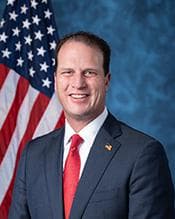
August Pfluger
Republican · TX · Representative
Votes with party: 98.9% (647 recorded votes)
Full profile: /officials/P000048
Source: Congress.gov · FEC
Cosponsors (1)
Members who have signed on to support this bill since introduction. Source: Congress.gov.
Latest Action
The most recent step in the bill's legislative path. Committee Activity below shows referrals and reports; the full action-by-action history including floor proceedings lives at Congress.gov →
Committee Activity
Currently in
- House Committee on Energy and CommerceReported By · 2026-09-14
Previously
- House Committee on Energy and CommerceMarkup By · 2026-07-20
- House Committee on Energy and CommerceReferred To · 2026-07-09
Plain-English Summary
Environmental Monitoring and Remediation Technology Assessment Initiative Authorization Act of 2026 or the EMRTAI Authorization Act of 2026 This provides statutory authority for an initiative within the Environmental Protection Agency (EPA) that recovers critical materials from contaminated sites. A critical material means (1) any non-fuel mineral, element, substance, or material that the Department of Energy determines has a high risk of a supply chain disruption and serves an essential function in energy technologies; and (2) any critical mineral. A critical mineral means any mineral, element, substance, or material designated as critical by the U.S. Geological Survey. Under the program, the EPA must investigate, evaluate, and support processes, methods, and systems which may be used to identify sources of critical materials at contaminated sites and recover such critical materials from those sites. In carrying out the program, the EPA may provide assistance (e.g., awards) to persons, nonprofit organizations, and state, local, and tribal government entities. The bill prohibits the EPA from providing assistance (1) in an amount that exceeds $10 million in any fiscal year in the aggregate; or (2) to any person, nonprofit organization, or government entity, in an amount that exceeds $3 million. The bill terminates the program after 10 years.
Plain-English rewrite of the Congressional Research Service summary published on Congress.gov. Cached and reviewed.
Subjects
Energy
Full Bill Text
Verbatim text published on Congress.gov via GovInfo. Use Cmd+F / Ctrl+F to search within this excerpt.
[Congressional Bills 119th Congress] [From the U.S. Government Publishing Office] [H.R. 9616 Introduced in House (IH)] <DOC> 119th CONGRESS 2d Session H. R. 9616 To establish a program for the recovery of critical materials from contaminated sites, and for other purposes. _______________________________________________________________________ IN THE HOUSE OF REPRESENTATIVES July 9, 2026 Mr. Pfluger (for himself and Mr. Landsman) introduced the following bill; which was referred to the Committee on Energy and Commerce _______________________________________________________________________ A BILL To establish a program for the recovery of critical materials from contaminated sites, and for other purposes. Be it enacted by the Senate and House of Representatives of the United States of America in Congress assembled, SECTION 1. SHORT TITLE. This Act may be cited as the ``Environmental Monitoring and Remediation Technology Assessment Initiative Authorization Act of 2026'' or the ``EMRTAI Authorization Act of 2026''. SEC. 2. ENVIRONMENTAL REMEDIATION AND CRITICAL MATERIAL RECOVERY PROGRAM. (a) Establishment.--The Administrator of the Environmental Protection Agency shall carry out a program to investigate, evaluate, and support processes, methods, and systems which may be utilized in-- (1) the identification of sources of critical materials at contaminated sites, including contaminated media and solid waste sources at such sites; and (2) the recovery of such critical materials from such sites. (b) Assistance.--In carrying out the program under subsection (a), the Administrator may provide assistance, including by entering into contracts and cooperative agreements and making awards, to persons, State, local, and Tribal government entities, and nonprofit organizations. (c) Limitation.--The Administrator may not, under such program, provide assistance-- (1) in the aggregate, in an amount that exceeds $10,000,000 in any fiscal year; or (2) to any person, State, local, or Tribal government entity, or nonprofit organization, in an amount that exceeds $3,000,000. (d) Evaluation of Applications.--The Administrator shall establish a system for evaluating applications for assistance provided under subsection (b) that includes the following criteria: (1) The extent to which the assistance furthers the identification of nontraditional, domestic sources of critical materials at contaminated sites pursuant to subsection (a). (2) The extent to which the assistance advances processes, methods, and systems for-- (A) recovering critical materials from sources at contaminated sites that may be identified pursuant to subsection (a); and (B) monitoring environmental contamination and remediation of such contaminated sites in the recovery of such critical materials. (3) The extent to which the assistance strengthens national security through the development of domestic critical material supply chains. (4) The extent to which the assistance supports remediation of one or more contaminated sites, especially such sites that are on the National Priorities List. (5) The extent to which the assistance protects human health and the environment. (e) Critical Material Defined.--In this section, the term ``critical material'' has the meaning given such term in section 7002(a) of the Energy Act of 2020 (30 U.S.C. 1606(a)). (f) Sunset.--The program under subsection (a) shall terminate on the date that is 10 years after the date of enactment of this section. <all>
Related legislation
Bills by the same sponsor or covering overlapping subjects.
- HR10197Biosecurity Modernization and Innovation ActReferred to Committee · 2026-08-31
- HJRES212Providing congressional disapproval under chapter 8 of title 5, United States Code, of the rule submitted by the Environmental Protection Agency relating to "California State Motor Vehicle Pollution Control Standards; Advanced Clean Car Program; Reconsideration of a Previous Withdrawal of a Waiver of Preemption; Notice of Decision".Referred to Committee · 2026-08-06
- HR9970RESCUE Act of 2026Referred to Committee · 2026-07-27
- HR9397Premium Transparency ActReferred to Committee · 2026-06-25