HR9769Referred to Committee
Duty of Transparency Act
Introduced
In Committee
3
Passed One Chamber4
Passed Both5
Signed into Law119th
Congress
2026-07-16
Introduced
1
Cosponsors
HR
ⓘType
Sponsor
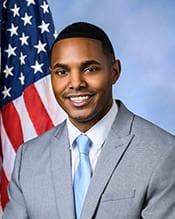
Ritchie Torres
Democrat · NY · Representative
Votes with party: 96.1% (618 recorded votes)
Full profile: /officials/T000486
Source: Congress.gov · FEC
Cosponsors (1)
Members who have signed on to support this bill since introduction. Source: Congress.gov.
Latest Action
The most recent step in the bill's legislative path. Committee Activity below shows referrals and reports; the full action-by-action history including floor proceedings lives at Congress.gov →
Committee Activity
Currently in
- House Committee on House AdministrationReferred To · 2026-07-16
Plain-English Summary
Members of Congress would be required to publicly disclose reasons for missing votes and committee meetings, along with information about how often they are absent. The disclosures would be made available to the public so voters can see which representatives are regularly missing work and why. This would affect all senators and representatives and aim to increase accountability for congressional attendance.
AI-assisted summary generated from the official bill metadata (title, subjects, actions) sourced from Congress.gov. Cached and reviewed. Always verify against the official text linked below.
Full Bill Text
Verbatim text published on Congress.gov via GovInfo. Use Cmd+F / Ctrl+F to search within this excerpt.
[Congressional Bills 119th Congress] [From the U.S. Government Publishing Office] [H.R. 9769 Introduced in House (IH)] <DOC> 119th CONGRESS 2d Session H. R. 9769 To require Members of Congress to provide disclosures related to absences from attendance, and for other purposes. _______________________________________________________________________ IN THE HOUSE OF REPRESENTATIVES July 16, 2026 Mr. Torres of New York (for himself and Mr. Moulton) introduced the following bill; which was referred to the Committee on House Administration _______________________________________________________________________ A BILL To require Members of Congress to provide disclosures related to absences from attendance, and for other purposes. Be it enacted by the Senate and House of Representatives of the United States of America in Congress assembled, SECTION 1. SHORT TITLE. This Act may be cited as the ``Duty of Transparency Act''. SEC. 2. DISCLOSURES RELATED TO PROLONGED ABSENCE FROM THE CONGRESS. (a) In General.--An individual who is a Member of Congress and who has a reasonable belief that the individual will not be physically present to participate in the proceedings of the applicable House of Congress of which the individual is a Member for a period of not less than 21 consecutive calendar days shall file a disclosure statement under subsection (b) with the designated attending officer of the House of Congress not later than 5 calendar days after having the reasonable belief. (b) Contents of Disclosure.--The disclosure statement referred to in subsection (a) shall include the following: (1) The expected dates during which the Member of Congress will not be physically present to participate. (2) A statement explaining why the Member of Congress will not be physically present to participate during the dates described in paragraph (1). (3) Whether the Member of Congress shall be able to perform official duties or responsibilities notwithstanding not being physically present, including through remote work, and, if so, a description of the duties or responsibilities. (4) Identification and contact information of an individual employed by the Member under the Members' Representational Allowance who shall have access to the Member should the need arise with respect to the House of Congress. (c) Incapacitation.--A Member of Congress who does not comply with subsection (a) despite being subject to such subsection because the Member was incapacitated or otherwise unable to comply shall file a disclosure statement under subsection (b) with the designated attending officer of the House of Congress not later than 5 calendar days after the end of the incapacitation or inability to comply. (d) Privacy.--A Member of Congress required to file a disclosure statement under this section shall not be required to disclose any diagnosis, prognosis, course of treatment, medical record, or other protected health information concerning the Member or another individual, but the disclosure statement may contain such additional information that the Member may choose to disclose beyond the information required under subsection (b). (e) Updates.--Every 30 days after the start of a period during which a Member of Congress is not physically present to participate in the proceedings of the applicable House of Congress and through the end of such period, the Member shall file a new disclosure statement that updates the information provided in the prior disclosure statement. (f) Public Availability.--The designated attending officer of each House of Congress shall make available to the general public, in a website under the authority of the officer, each disclosure statement filed with the officer not later than 2 calendar days after the filing. (g) Enforcement.--The failure to comply with this section shall be a matter in the jurisdiction of the applicable ethics committee. (h) Rulemaking Authority.--This section is enacted as an exercise in the rulemaking power of…
Show the remaining 395 wordsHide the remaining 395 words
the House of Representatives and the Senate, respectively, and as such shall be considered as part of the rules of each House, with full recognition of the constitutional right of either House to change such rules at any time, in the same manner, and to the same extent, as any other rule of that House. (i) Effective Date.--This section shall apply with respect to any period during which a Member of Congress is not physically present to participate in the proceedings of the applicable House of Congress that begins after the date of the enactment of this section. (j) Definitions.--In this section: (1) Applicable ethics committee.--The term ``applicable ethics committee'' means-- (A) with respect to the House of Representatives, the Committee on Ethics of the House of Representatives; and (B) with respect to the Senate, the Select Committee on Ethics of the Senate. (2) Area of constituency.--The term ``area of constituency'' means-- (A) with respect to a Representative in, or a Delegate or Resident Commissioner to, the Congress, the congressional district of the Representative, Delegate, or Resident Commissioner; and (B) with respect to a Senator in the Congress, the State of the Senator. (3) Designated attending officer.--The term ``designated attending officer'' means-- (A) with respect to the House of Representatives, the Clerk of the House of Representatives, or an officer or employee of the House of Representatives designated by the Clerk; and (B) with respect to the Senate, the Secretary of the Senate, or an officer or employee of the Senate designated by the Secretary. (4) Member of congress.--The term ``Member of Congress'' means a Senator or Representative in, or a Delegate or Resident Commissioner to, the Congress. (5) Physically present to participate in the proceedings.-- The term ``physically present to participate in the proceedings'' includes, with respect to a House of Congress, entering the Capitol Buildings (as such term is defined in section 5101 of title 40, United States Code), entering the office of a Member of Congress in the Capitol Buildings or in the area of constituency of the Member which is accessible to the general public, entering the applicable Hall or Chamber of such House, casting or making a vote in such House, making a motion or request for unanimous consent on the floor of such House, or engaging in any other activity that requires physical presence in the Capitol Buildings. <all>
Related legislation
Bills by the same sponsor or covering overlapping subjects.
- HR9532No Medicare Clawbacks Act of 2026Referred to Committee · 2026-06-29
- HR8669To designate the facility of the United States Postal Service located at 5951 Riverdale Avenue in Bronx, New York, as the "Eliot L. Engel Post Office".Reported by Committee · 2026-05-20
- HR8912Campaign Funds Integrity Act of 2026Referred to Committee · 2026-05-19
- HR8562To designate a building of the Chancery of the United States in Pristina, Kosovo, as the "Eliot L. Engel Building".Reported by Committee · 2026-05-13