HR9997Referred to Committee
To establish a pilot program to address critical workforce integration and national security imperatives.
Introduced
In Committee
3
Passed One Chamber4
Passed Both5
Signed into Law119th
Congress
2026-07-30
Introduced
2
Cosponsors
HR
ⓘType
Sponsor
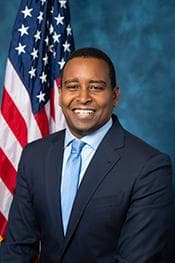
Joe Neguse
Democrat · CO · Representative
Votes with party: 98.0% (641 recorded votes)
Top industries funding sponsor:
- Progressive Groups$78k
Full profile: /officials/N000191
Source: Congress.gov · FEC
Cosponsors (2)
Members who have signed on to support this bill since introduction. Source: Congress.gov.
Latest Action
The most recent step in the bill's legislative path. Committee Activity below shows referrals and reports; the full action-by-action history including floor proceedings lives at Congress.gov →
Referred to the Committee on Education and Workforce, and in addition to the Committee on Armed Services, for a period to be subsequently determined by the Speaker, in each case for consideration of such provisions as fall within the jurisdiction of the committee concerned.
2026-07-30
Source: Congress.gov
Committee Activity
Currently in
- House Committee on Education and WorkforceReferred To · 2026-07-30
- House Committee on Armed ServicesReferred To · 2026-07-30
Plain-English Summary
The bill would create a test program to help integrate workers into critical jobs while addressing national security needs, though the specific details of how it would work are not yet clear from the title alone. The program would likely involve coordination between education, workforce development, and military or defense-related agencies to ensure the country has trained personnel for important positions. Workers in defense, technology, or other security-sensitive fields could potentially be affected by new training or employment requirements under this pilot program.
AI-assisted summary generated from the official bill metadata (title, subjects, actions) sourced from Congress.gov. Cached and reviewed. Always verify against the official text linked below.
Full Bill Text
Verbatim text published on Congress.gov via GovInfo. Use Cmd+F / Ctrl+F to search within this excerpt.
[Congressional Bills 119th Congress] [From the U.S. Government Publishing Office] [H.R. 9997 Introduced in House (IH)] <DOC> 119th CONGRESS 2d Session H. R. 9997 To establish a pilot program to address critical workforce integration and national security imperatives. _______________________________________________________________________ IN THE HOUSE OF REPRESENTATIVES July 30, 2026 Mr. Neguse (for himself, Ms. Houlahan, and Mr. Kiley of California) introduced the following bill; which was referred to the Committee on Education and Workforce, and in addition to the Committee on Armed Services, for a period to be subsequently determined by the Speaker, in each case for consideration of such provisions as fall within the jurisdiction of the committee concerned _______________________________________________________________________ A BILL To establish a pilot program to address critical workforce integration and national security imperatives. Be it enacted by the Senate and House of Representatives of the United States of America in Congress assembled, SECTION 1. SHORT TITLE. This Act may be cited as the ``National Guard for National Service Act of 2026''. SEC. 2. PILOT PROGRAM TO ADDRESS CRITICAL WORKFORCE INTEGRATION AND NATIONAL SECURITY IMPERATIVES. (a) In General.--After the conclusion of the study under subsection (b), the Chief of the National Guard Bureau and the Chief Executive Officer of the Corporation for National and Community Service shall establish a pilot program, informed by the study under subsection (b), to address critical workforce integration and national security imperatives through activities conducted by the National Guard Bureau and under the national service laws, which shall include the following: (1) Critical infrastructure protection.--Activities to proactively safeguard essential systems and assets that are vital for the functioning of the society and economy of the United States, including systems of transportation, energy, communications, and water management. (2) Cybersecurity capacity-building.--Activities related to the training and deployment of participants and members of the National Guard to assist local and Tribal governments, elementary and secondary schools, institutions of higher education, and nonprofits in strengthening their security protocols and resilience. (3) Disaster preparedness and community resilience.-- Activities to expand efforts in community preparedness and resilience to reduce risks to civilian life and strategic infrastructure due to major disasters and ensure their ability to be resilient should an event occur. (4) Workforce development and financial security.-- Activities to establish a nationwide employment and training pipeline that-- (A) connects part-time National Guard and Reserve service members with structured career pathways through programs established under the national service laws; (B) addresses economic insecurity; and (C) ensures workforce stability. (b) Feasibility Study.--Not later than 1 year after the date of enactment of this Act, the Chief of the National Guard Bureau and the Chief Executive Officer of the Corporation for National and Community Service shall jointly conduct a feasibility study regarding-- (1) the actions and procedural modifications that would be necessary to develop a dedicated nationwide employment and training pipeline for members of a reserve component to participate in programs carried out under the national service laws; (2) modifications necessary to the terms of service for a participant under the national service laws to accommodate training schedules and deployment of military service members; (3) quantifiable benefits anticipated with respect to the establishment of such a pipeline; (4) financial and administrative costs of the implementation of the pilot program under subsection (a); (5) the percentage of members of a reserve component who lack access to stable, full-time employment; (6) the expected levels of participation by military service members seeking employment and training opportunities in programs carried out under the national service laws; (7) the framework for the design and operationalization of such a pipeline; and (8) whether a dedicated nationwide employment and training…
Show the remaining 109 wordsHide the remaining 109 words
pipeline to participation in programs carried out under the national service laws is an effective tool for enhancing employment and upskilling opportunities for military spouses and dependents. (c) Definitions.--For purposes of this section: (1) National guard.--The term ``national guard'' has the meaning given such term in section 101 of title 32, United States Code. (2) National service laws.--The term ``national service laws'' has the meaning given such term in section 101 of the National and Community Service Act of 1990 (42 U.S.C. 12511). (3) Participant.--The term ``participant'' has the meaning given such term in section 101 of the National and Community Service Act of 1990 (42 U.S.C. 12511). <all>
Related legislation
Bills by the same sponsor or covering overlapping subjects.
- HR9966Safe Spaces for All ActReferred to Committee · 2026-07-27
- HR9924Local Input ActReferred to Committee · 2026-07-23
- HR9863To direct the Director of the Defense Health Agency to submit to Congress a report on the feasibility of establishing a pilot program that establishes a behavioral neurology fellowship program to provide training opportunities with respect to treating members of the Armed Forces and veterans with traumatic brain injuries.Referred to Committee · 2026-07-22
- HR9864Reducing Military Health Care Wait Times ActReferred to Committee · 2026-07-22