HRES1448Referred to Committee
Expressing support for the designation of August 1 as "National Woman Astronomers Day".
Introduced
In Committee
3
Passed One Chamber4
Passed Both5
Signed into Law119th
Congress
2026-07-22
Introduced
0
Cosponsors
HRES
ⓘType
Sponsor
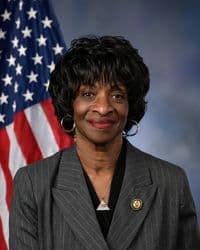
Valerie P. Foushee
Democrat · NC · Representative
Votes with party: 98.1% (627 recorded votes)
Top industries funding sponsor:
- Progressive Groups$400k
- Climate & Environment$1k
Full profile: /officials/F000477
Source: Congress.gov · FEC
Cosponsors (0)
Members who have signed on to support this bill since introduction. Source: Congress.gov.
No cosponsors on record. Bills can pass without cosponsors — this often means the sponsor introduced the bill alone, either because it's a messaging bill, a chairman's mark, or simply early in the legislative cycle.
Latest Action
The most recent step in the bill's legislative path. Committee Activity below shows referrals and reports; the full action-by-action history including floor proceedings lives at Congress.gov →
Committee Activity
Currently in
- House Committee on Science, Space, and TechnologyReferred To · 2026-07-22
Plain-English Summary
The resolution would officially recognize August 1 as "National Woman Astronomers Day" to honor the contributions of women in astronomy and encourage more people to learn about their achievements. This designation would raise awareness about female astronomers throughout history and their important discoveries in space science. The recognition could inspire young women and girls to pursue careers in astronomy and related fields.
AI-assisted summary generated from the official bill metadata (title, subjects, actions) sourced from Congress.gov. Cached and reviewed. Always verify against the official text linked below.
Full Bill Text
Verbatim text published on Congress.gov via GovInfo. Use Cmd+F / Ctrl+F to search within this excerpt.
[Congressional Bills 119th Congress] [From the U.S. Government Publishing Office] [H. Res. 1448 Introduced in House (IH)] <DOC> 119th CONGRESS 2d Session H. RES. 1448 Expressing support for the designation of August 1 as ``National Woman Astronomers Day''. _______________________________________________________________________ IN THE HOUSE OF REPRESENTATIVES July 22, 2026 Mrs. Foushee submitted the following resolution; which was referred to the Committee on Science, Space, and Technology _______________________________________________________________________ RESOLUTION Expressing support for the designation of August 1 as ``National Woman Astronomers Day''. Whereas ``National Woman Astronomers Day'' recognizes and emphasizes the importance of American women in astronomy, including-- (1) Maria Mitchell, the first American astronomer to discover a comet, the first woman appointed as a professor of astronomy in the United States, and a co-founder of the Association for the Advancement of Women; (2) Dr. Annie Jump Cannon, a pioneer in the classification of stars and the first woman elected as an officer of the American Astronomical Society; (3) Henrietta Swan Leavitt, who discovered a way to reliably calculate vast distances to astronomical objects, which led to a shift in the understanding of the scale and nature of the universe; (4) Dr. Cecilia Payne-Gaposchkin, who determined that stars are composed primarily of hydrogen and helium and was the first woman to serve as a department chair at Harvard University; (5) Dr. Nancy Grace Roman, the first woman to hold a senior executive role at the National Aeronautics and Space Administration, its first Chief of Astronomy, and widely known as ``The Mother of Hubble'' for her foundational role in developing the Hubble Space Telescope, and for whom the Nancy Grace Roman Space Telescope is named; (6) Dr. Vera C. Rubin, whose observations of galaxy rotation curves provided key evidence for dark matter, and for whom the National Science Foundation Department of Energy Vera C. Rubin Observatory is named--the first United States national observatory named after a woman; (7) Dr. E. Margaret Burbidge, who discovered how elements are formed in stars and revolutionized our understanding of stellar nucleosynthesis and served as the first female president of the American Astronomical Society; (8) Dr. Barbara A. Williams, a leader in characterizing the hydrogen content of compact galaxy clusters with radio observations and the first African-American woman to earn a doctorate in astronomy; (9) Dr. Sidney C. Wolff, whose research gave insight into magnetic stars and was the first woman to lead a United States National Observatory; (10) Dr. Wendy Freedman, who conducts groundbreaking research on cosmology and the Hubble constant, refining the current estimate of the universe's expansion rate; (11) Dr. Elisa Quintana, who discovered the first Earth-sized exoplanet found in the habitable zone of a star other than the Sun; (12) Dr. Jane Luu, a leader in the discovery and early characterization of Kuiper Belt objects and the first woman to be awarded the Shaw Prize in Astronomy; (13) Dr. Andrea Ghez, who led research providing compelling evidence for a supermassive black hole at the center of the Milky Way and is the only woman to ever win a Nobel Prize for astronomy research; and (14) countless other women whose pioneering achievements and dedication have expanded the frontiers of astronomy; Whereas women's contributions in the field of astronomy have been critical to its success; Whereas women currently make up only 30 percent of the astronomical workforce; Whereas increasing the number of women in the field of astronomy will be critical to maintaining a competitive workforce and programs; and Whereas diversity in any field incorporates different experiences, which can ultimately lead to more creative and pioneering solutions: Now, therefore, be it Resolved, That the House of Representatives--…
Show the remaining 77 wordsHide the remaining 77 words
(1) recognizes the celebration of ``National Woman Astronomers Day'' as a time to reflect on the many notable contributions that women have made to the field of astronomy in the United States; (2) urges the people of the United States to observe ``National Woman Astronomers Day'' with appropriate programs and activities; and (3) affirms the commitment of the House of Representatives to ensuring that all women have equal access to opportunity in the field of astronomy. <all>
Related legislation
Bills by the same sponsor or covering overlapping subjects.
- HR9852To amend title 23, United States Code, to include super speeder programs in State highway safety programs, and for other purposes.Referred to Committee · 2026-07-22
- HR9677Grad Student Affordable Housing Act of 2026Referred to Committee · 2026-07-14
- HR9619To require artificial intelligence chatbot providers to provide data privacy and security, and for other purposes.Referred to Committee · 2026-07-09
- HR8893Protecting Consumers from Deceptive AI ActReferred to Committee · 2026-07-07