HRES1558Referred to Committee
Expressing the sense of the House of Representatives that, to maintain the health care safety net, Federally Qualified Health Centers should continue to operate under their longstanding single patient definition for delivery of all services, including prescription drugs.
Introduced
In Committee
3
Passed One Chamber4
Passed Both5
Signed into Law119th
Congress
2026-09-17
Introduced
1
Cosponsors
HRES
ⓘType
Sponsor
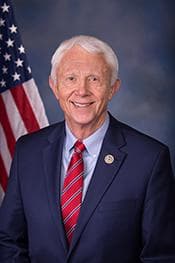
Jack Bergman
Republican · MI · Representative
Votes with party: 98.8% (657 recorded votes)
Full profile: /officials/B001301
Source: Congress.gov · FEC
Cosponsors (1)
Members who have signed on to support this bill since introduction. Source: Congress.gov.
Latest Action
The most recent step in the bill's legislative path. Committee Activity below shows referrals and reports; the full action-by-action history including floor proceedings lives at Congress.gov →
Committee Activity
Currently in
- House Committee on Energy and CommerceReferred To · 2026-09-17
Plain-English Summary
Plain-English summary pending. Introduced on 2026-09-17. Check back soon — summaries are generated as bills progress through Congress.
Full Bill Text
Verbatim text published on Congress.gov via GovInfo. Use Cmd+F / Ctrl+F to search within this excerpt.
[Congressional Bills 119th Congress] [From the U.S. Government Publishing Office] [H. Res. 1558 Introduced in House (IH)] <DOC> 119th CONGRESS 2d Session H. RES. 1558 Expressing the sense of the House of Representatives that, to maintain the health care safety net, Federally Qualified Health Centers should continue to operate under their longstanding single patient definition for delivery of all services, including prescription drugs. _______________________________________________________________________ IN THE HOUSE OF REPRESENTATIVES September 17, 2026 Mr. Bergman (for himself and Mr. Davis of North Carolina) submitted the following resolution; which was referred to the Committee on Energy and Commerce _______________________________________________________________________ RESOLUTION Expressing the sense of the House of Representatives that, to maintain the health care safety net, Federally Qualified Health Centers should continue to operate under their longstanding single patient definition for delivery of all services, including prescription drugs. Whereas nearly 1,400 Federally Qualified Health Centers (referred to in this preamble as ``health centers'') form the backbone of the health care safety net, serving more than 32 million medically underserved Americans at more than 16,000 sites; Whereas health centers play an essential role in meeting our Nation's moral commitment to maintain a strong health care safety net; Whereas health centers provide high-quality, affordable care to 1 in 8 children in the United States, 1 in 5 rural residents, and more than 25 million individuals who are enrolled in Medicare or Medicaid or are uninsured; Whereas approximately 90 percent of health center patients have incomes at or below 200 percent of the Federal poverty line; Whereas the Health Resources and Services Administration has long applied a single definition of a health center patient, currently stated as ``an individual who has at least one countable visit during the calendar year in one or more categories of services: medical, dental, mental health, substance use disorder, vision, other professional, or enabling''; Whereas this single patient definition minimizes administrative costs and maximizes the effectiveness of health centers, thereby strengthening the health care safety net for every health center patient; Whereas imposing conflicting, service-specific patient definitions would restrict the services covered by this definition, forcing health centers to deny patients access to the full range of health care services and damaging the safety net for millions of Americans; Whereas, consistent with the role health centers play in providing patients a full range of services, Congress has supported the patient-centered medical home model so that patients receive coordinated care involving multiple providers without losing their relationship with their primary care provider; Whereas service-specific patient definitions conflict with the purposes of section 330 of the Public Health Service Act (42 U.S.C. 254b), a key part of the legal foundation of the health care safety net, and undermine the coordinated care that the patient-centered medical home model is designed to provide; Whereas prescription drugs play an increasingly important role in improving the health and quality of life of Americans, yet 6 in 10 adults in the United States worry about being able to afford their prescription drug costs; Whereas, recognizing the essential role of prescription drugs in health care, Congress established the Medicaid Drug Rebate Program and the 340B Drug Pricing Program to help ensure that the health care safety net can provide patients with access to affordable prescription drugs; Whereas the stated purpose of the 340B Drug Pricing Program is to enable covered entities to ``stretch scarce Federal resources as far as possible, reaching more eligible patients and providing more comprehensive services''; and Whereas any restriction on the ability of health centers to provide 340B drugs to all of their patients threatens the health care safety net: Now, therefore, be it…
Show the remaining 64 wordsHide the remaining 64 words
Resolved, That the House of Representatives affirms that, given the essential role of Federally Qualified Health Centers in the health care safety net, such health centers should continue to operate under their longstanding, single patient definition for all services, including drugs purchased under the 340B Drug Pricing Program, to ensure that their patients have access to the full range of health care services. <all>
Related legislation
Bills by the same sponsor or covering overlapping subjects.
- HR10419To direct the Secretary of Veterans Affairs to establish a pilot program to improve access to and awareness of community-based dental services for veterans residing in rural areas, and for other purposes.Referred to Committee · 2026-09-16
- HR6835Veterans STAND ActReferred to Committee · 2026-06-30
- HR6549VA Contracting and Procurement ActReferred to Committee · 2026-05-20
- HR6993BEACON Act of 2026Referred to Committee · 2026-05-14