S4777Referred to Committee
Blast Overpressure Research and Mitigation Task Force Act
Introduced
In Committee
3
Passed One Chamber4
Passed Both5
Signed into Law119th
Congress
2026-06-11
Introduced
0
Cosponsors
S
ⓘType
Sponsor
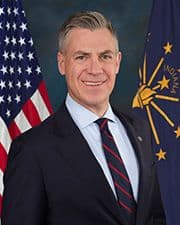
Jim Banks
Republican · IN · Senator
Votes with party: 75.2% (830 recorded votes)
Full profile: /officials/B001299
Source: Congress.gov · FEC
Cosponsors (0)
Members who have signed on to support this bill since introduction. Source: Congress.gov.
No cosponsors on record. Bills can pass without cosponsors — this often means the sponsor introduced the bill alone, either because it's a messaging bill, a chairman's mark, or simply early in the legislative cycle.
Latest Action
The most recent step in the bill's legislative path. Committee Activity below shows referrals and reports; the full action-by-action history including floor proceedings lives at Congress.gov →
Committee Activity
Currently in
- Senate Committee on Veterans' AffairsReferred To · 2026-06-11
Plain-English Summary
The Department of Veterans Affairs would create a task force to study and address blast overpressure injuries—the invisible wounds caused by explosions that affect many veterans from Iraq and Afghanistan. The task force would research these injuries, improve how they're diagnosed and treated, and develop better support programs for affected veterans. This effort aims to better understand a serious health problem that has impacted thousands of service members but remains less visible than other combat injuries.
AI-assisted summary generated from the official bill metadata (title, subjects, actions) sourced from Congress.gov. Cached and reviewed. Always verify against the official text linked below.
Full Bill Text
Verbatim text published on Congress.gov via GovInfo. Use Cmd+F / Ctrl+F to search within this excerpt.
[Congressional Bills 119th Congress] [From the U.S. Government Publishing Office] [S. 4777 Introduced in Senate (IS)] <DOC> 119th CONGRESS 2d Session S. 4777 To establish the Blast Overpressure Task Force of the Department of Veterans Affairs, and for other purposes. _______________________________________________________________________ IN THE SENATE OF THE UNITED STATES June 11, 2026 Mr. Banks introduced the following bill; which was read twice and referred to the Committee on Veterans' Affairs _______________________________________________________________________ A BILL To establish the Blast Overpressure Task Force of the Department of Veterans Affairs, and for other purposes. Be it enacted by the Senate and House of Representatives of the United States of America in Congress assembled, SECTION 1. SHORT TITLE. This Act may be cited as the ``Blast Overpressure Research and Mitigation Task Force Act''. SEC. 2. ESTABLISHMENT OF THE BLAST OVERPRESSURE TASK FORCE OF THE DEPARTMENT OF VETERANS AFFAIRS. (a) Establishment.--Not later than 180 days after the date of the enactment of this Act, the Secretary of Veterans Affairs shall, through the Department of Veterans Affairs-Department of Defense Joint Executive Committee under section 320 of title 38, United States Code-- (1) establish the Blast Overpressure Task Force of the Department of Veterans Affairs (in this section referred to as the ``Task Force''); and (2) appoint the members of the Task Force. (b) Membership.--Each member of the Task Force appointed under subsection (a)(2) shall be a member of the Health Executive Committee under section 320(b)(2) of title 38, United States Code, who, at the time of appointment, is involved in research regarding the mitigation and treatment of blast overpressure or blast exposure. (c) Duties.--The duties of the Task Force are the following: (1) To improve how the Secretary of Veterans Affairs, in consultation with the Secretary of Defense, provides health care and other benefits to veterans or members of the Armed Forces diagnosed with traumatic brain injury, post-traumatic stress disorder, or other symptoms, from blast overpressure or blast exposure. (2) To align research agendas and acquisition strategies of the Department of Veterans Affairs regarding such health care. (3) To establish physiological and cognitive performance baselines for such veterans and members. (4) To prioritize translational research regarding such veterans and members, including research regarding-- (A) sleep therapy; (B) blast-related gut health; (C) mobile diagnostics; (D) vestibular dysfunction and balance impairment; (E) autonomic nervous system dysregulation; (F) cumulative mild traumatic brain injury; (G) neuroinflammation and glial activation; and (H) any other issue determined appropriate by the Secretary of Veterans Affairs. (5) To monitor sensory decline (including with respect to vision, hearing, and vestibular function) and stress-related impairments among such veterans and members. (6) To support continuity of such health care by integrating mobile and longitudinal diagnostic tools. (d) Reports.-- (1) In general.--Not later than one year after the establishment of the Task Force under subsection (a), and not less frequently than annually thereafter, the Task Force shall submit to the Committee on Veterans' Affairs and the Committee on Armed Services of the Senate and the Committee on Veterans' Affairs and the Committee on Armed Services of the House of Representatives a report on the activities of the Task Force. (2) Elements.--Each report under paragraph (1) shall include the following: (A) Details of research initiatives, coordination outcomes, and clinical advancements of the Task Force. (B) Recommendations of the Task Force regarding-- (i) how claims processors of the Department of Veterans Affairs should evaluate evidence that links conditions researched by the Task Force to active military, naval, air, or space service (as defined in section 101 of title 38, United States Code); and (ii) best practices regarding the evaluation of neurological injuries…
Show the remaining 26 wordsHide the remaining 26 words
in examinations for benefits under chapter 11 or 15 of title 38, United States Code. (e) Sunset.--The Task Force shall terminate on September 30, 2029. <all>
Related legislation
Bills by the same sponsor or covering overlapping subjects.
- S4741SAFE for Kids Act of 2026Referred to Committee · 2026-06-10
- S4658Parkinson’s Protection for Firefighters ActReferred to Committee · 2026-06-02
- S4607DOD and USDA Interagency Research ActReferred to Committee · 2026-05-20
- S4525Securing Innovation and Research from Adversaries ActReferred to Committee · 2026-05-14