S5107Referred to Committee
No Corporate Crooks Act
Introduced
In Committee
3
Passed One Chamber4
Passed Both5
Signed into Law119th
Congress
2026-07-23
Introduced
0
Cosponsors
S
ⓘType
Sponsor
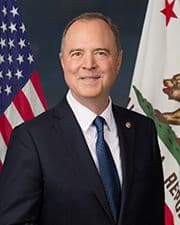
Adam B. Schiff
Democrat · CA · Senator
Votes with party: 82.1% (854 recorded votes)
Full profile: /officials/S001150
Source: Congress.gov · FEC
Cosponsors (0)
Members who have signed on to support this bill since introduction. Source: Congress.gov.
No cosponsors on record. Bills can pass without cosponsors — this often means the sponsor introduced the bill alone, either because it's a messaging bill, a chairman's mark, or simply early in the legislative cycle.
Latest Action
The most recent step in the bill's legislative path. Committee Activity below shows referrals and reports; the full action-by-action history including floor proceedings lives at Congress.gov →
Read twice and referred to the Committee on Homeland Security and Governmental Affairs.
2026-07-23
Source: Congress.gov
Committee Activity
Currently in
- Senate Committee on Homeland Security and Governmental AffairsReferred To · 2026-07-23
Plain-English Summary
The bill would prevent people who have been convicted of corruption-related crimes from working as chief executive officers in federal government agencies. This restriction would apply to executives in the executive branch of government, which includes federal agencies and departments. The measure aims to ensure that people convicted of corruption crimes cannot hold top leadership positions in the federal government.
AI-assisted summary generated from the official bill metadata (title, subjects, actions) sourced from Congress.gov. Cached and reviewed. Always verify against the official text linked below.
Full Bill Text
Verbatim text published on Congress.gov via GovInfo. Use Cmd+F / Ctrl+F to search within this excerpt.
[Congressional Bills 119th Congress] [From the U.S. Government Publishing Office] [S. 5107 Introduced in Senate (IS)] <DOC> 119th CONGRESS 2d Session S. 5107 To prohibit chief executive officers convicted of crimes relating to corruption from serving in the executive branch, and for other purposes. _______________________________________________________________________ IN THE SENATE OF THE UNITED STATES July 23, 2026 Mr. Schiff introduced the following bill; which was read twice and referred to the Committee on Homeland Security and Governmental Affairs _______________________________________________________________________ A BILL To prohibit chief executive officers convicted of crimes relating to corruption from serving in the executive branch, and for other purposes. Be it enacted by the Senate and House of Representatives of the United States of America in Congress assembled, SECTION 1. SHORT TITLE. This Act may be cited as the ``No Corporate Crooks Act''. SEC. 2. RESTRICTION ON SERVICE IN THE EXECUTIVE BRANCH. (a) Restriction.-- (1) In general.--Any individual who is finally convicted of a covered crime for which any portion of the conduct constituting the covered crime was committed while the individual was serving or employed as the chief executive officer of any public or private non-Federal entity, without regard to whether the conduct was committed in the course of the official duties of the individual as chief executive officer, shall be ineligible for appointment to a position in the executive branch of the Federal Government. (2) Covered crime defined.--In this subsection, the term ``covered crime'' means any of the following: (A) Any corruption-related offense under Federal law, which includes the following: (i) Bribery, which includes a violation of section 201 or 666 of title 18, United States Code. (ii) Copyright infringement, which includes a violation of chapter 5 of title 17, United States Code. (iii) Cybercrime, which includes a violation of section 1030 of title 18, United States Code. (iv) Embezzlement, which includes a violation of chapter 31 of title 18, United States Code. (v) Fraud, which includes a violation of chapter 63 of title 18, United States Code. (vi) Insider trading, which includes a violation of section 10 of the Securities Exchange Act of 1934 (15 U.S.C. 78j). (vii) Wage theft, which includes a violation of the Fair Labor Standards Act of 1938 (29 U.S.C. 201 et seq.). (viii) Tax evasion, which includes a violation of section 7201 of the Internal Revenue Code of 1986. (B) Any offense under the law of a State that is comparable to an offense under Federal law described in subparagraph (A). (b) Penalty.--Any individual serving in a position in the executive branch of the Federal Government on the date of enactment of this Act who would not be eligible for appointment to such a position under subsection (a) shall be removed from service or employment in the executive branch of the Federal Government. <all>
Related legislation
Bills by the same sponsor or covering overlapping subjects.
- S3720Bay Area Ridge National Scenic Trail Feasibility Study ActReferred to Committee · 2026-07-29
- S5135AI Ads ActReferred to Committee · 2026-07-27
- S5136Promoting Authenticity with Influencer Disclaimers ActReferred to Committee · 2026-07-27
- S5105A bill to establish the applicability of antitrust laws to the sharing of artificial intelligence frontier model risks, and for other purposes.Referred to Committee · 2026-07-23