HR9790Referred to Committee
Modernizing Opioid Treatment Access Act 2.0 of 2026
Introduced
In Committee
3
Passed One Chamber4
Passed Both5
Signed into Law119th
Congress
2026-07-20
Introduced
2
Cosponsors
HR
ⓘType
Sponsor
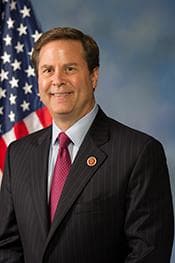
Donald Norcross
Democrat · NJ · Representative
Votes with party: 97.3% (515 recorded votes)
Top industries funding sponsor:
- Climate & Environment$11k
Full profile: /officials/N000188
Source: Congress.gov · FEC
Cosponsors (2)
Members who have signed on to support this bill since introduction. Source: Congress.gov.
Latest Action
The most recent step in the bill's legislative path. Committee Activity below shows referrals and reports; the full action-by-action history including floor proceedings lives at Congress.gov →
Referred to the Committee on Energy and Commerce, and in addition to the Committee on the Judiciary, for a period to be subsequently determined by the Speaker, in each case for consideration of such provisions as fall within the jurisdiction of the committee concerned.
2026-07-20
Source: Congress.gov
Committee Activity
Currently in
- House Committee on the JudiciaryReferred To · 2026-07-20
- House Committee on Energy and CommerceReferred To · 2026-07-20
Plain-English Summary
This bill would make it easier for people struggling with opioid addiction to access medication-based treatment by updating federal rules that currently limit how many patients doctors can treat and where treatment can happen. The changes would allow more healthcare providers, including those in rural areas and community health centers, to offer opioid addiction medications like methadone and buprenorphine. These updates aim to reduce barriers that prevent people from getting the help they need to overcome opioid dependence.
AI-assisted summary generated from the official bill metadata (title, subjects, actions) sourced from Congress.gov. Cached and reviewed. Always verify against the official text linked below.
Full Bill Text
Verbatim text published on Congress.gov via GovInfo. Use Cmd+F / Ctrl+F to search within this excerpt.
[Congressional Bills 119th Congress] [From the U.S. Government Publishing Office] [H.R. 9790 Introduced in House (IH)] <DOC> 119th CONGRESS 2d Session H. R. 9790 To expand access to methadone through alternative care models using pharmacies. _______________________________________________________________________ IN THE HOUSE OF REPRESENTATIVES July 20, 2026 Mr. Norcross (for himself, Mr. Lawler, and Mr. Tonko) introduced the following bill; which was referred to the Committee on Energy and Commerce, and in addition to the Committee on the Judiciary, for a period to be subsequently determined by the Speaker, in each case for consideration of such provisions as fall within the jurisdiction of the committee concerned _______________________________________________________________________ A BILL To expand access to methadone through alternative care models using pharmacies. Be it enacted by the Senate and House of Representatives of the United States of America in Congress assembled, SECTION 1. SHORT TITLE. This Act may be cited as the ``Modernizing Opioid Treatment Access Act 2.0 of 2026''. SEC. 2. EXPANSION OF METHADONE FOR OPIOID USE DISORDER THROUGH PRESCRIBING AND PHARMACIES. Section 303(h) of the Controlled Substances Act (21 U.S.C. 823(h)) is amended-- (1) in paragraph (2)-- (A) by striking ``(A)'' and inserting ``(i)''; and (B) by striking ``(B)'' and inserting ``(ii)''; (2) by redesignating paragraphs (1), (2), and (3) as subparagraphs (A), (B), and (C), respectively; (3) by striking ``(h) Practitioners'' and inserting ``(h)(1) Practitioners''; and (4) by adding at the end the following: ``(2)(A) The requirements of paragraph (1) applicable to methadone medication for opioid use disorder are waived, and the Attorney General, in consultation with the Secretary, shall separately register practitioners described in subparagraph (B) of this paragraph to prescribe methadone for opioid use disorder to be dispensed through a pharmacy to individuals for their own supervised or unsupervised use. ``(B) Practitioners described in this subparagraph are persons who-- ``(i) are licensed, registered, or otherwise permitted, by the United States or the jurisdiction in which they practice, to prescribe controlled substances in the course of professional practice; and ``(ii) are-- ``(I) addiction medicine physicians or addiction psychiatrists who hold a subspecialty board certification in addiction medicine from the American Board of Preventive Medicine, a board certification in addiction medicine from the American Board of Addiction Medicine, a subspecialty board certification in addiction psychiatry from the American Board of Psychiatry and Neurology, or a subspecialty board certification in addiction medicine from the American Osteopathic Association; or ``(II) otherwise determined by the Secretary, under standards established by the Secretary, to be qualified to prescribe methadone for opioid use disorder. ``(C) The prescribing of methadone pursuant to subparagraph (A) shall be-- ``(i) exclusively by electronic prescribing and dispensed to the individual treated pursuant to subparagraph (A); ``(ii) in compliance with applicable Federal and State law respecting the quantities of methadone for opioid use disorder that may be dispensed to individuals pursuant to subparagraph (A); and ``(iii) for a liquid or dispersible tablet formulation. ``(D) The dispensing of methadone to an individual pursuant to subparagraph (A) shall be in addition to the other care that the individual continues to have access to through an opioid use disorder treatment program. ``(E) Practitioners registered pursuant to subparagraph (A) shall-- ``(i) ensure and document, with respect to each individual treated pursuant to subparagraph (A), informed consent to treatment; and ``(ii) include in such informed consent, specific informed consent regarding differences in confidentiality protections applicable when dispensing through an opioid treatment program versus dispensing through a pharmacy pursuant to subparagraph (A). ``(F) At the request of a State, the Attorney General shall-- ``(i) cease registering persons in the State pursuant to subparagraph (A); ``(ii) revoke any such registration…
Show the remaining 236 wordsHide the remaining 236 words
in effect for a person in the State pursuant to section 304; and ``(iii) deny any pending application for such registration from a practitioner in the State pursuant to section 304. ``(G) Maintenance treatment or detoxification treatment provided pursuant to subparagraph (A) may be provided through the practice of telemedicine. ``(H) A pharmacy shall not be required to obtain a separate registration to dispense methadone medication for opioid use disorder to an individual who has been prescribed that medication by a practitioner registered pursuant to subparagraph (A). ``(3) Not later than 180 days after the date of enactment of this paragraph, and annually thereafter, the Administrator of the Drug Enforcement Administration shall submit to Congress a report that includes, for the reporting period-- ``(A) the number of practitioners registered pursuant to paragraph (2)(A) in each State; ``(B) a list of States for which the Attorney General received a request pursuant to paragraph (2)(F); ``(C) the number of revocations or suspensions of registration issued pursuant to section 304, based on violations related to the prescribing of methadone for opioid use disorder by practitioners who are registered pursuant to paragraph (2)(A); and ``(D) the number of pharmacies that ordered methadone in liquid or dispersible tablet formulations.''. SEC. 3. EFFECTIVE DATE. This Act and the amendments made by this Act shall take effect on the date that is 180 days after the date of enactment of this Act. <all>
Related legislation
Bills by the same sponsor or covering overlapping subjects.
- HR9684PATH ActReferred to Committee · 2026-07-14
- HRES1392Supporting the designation of a "National Learn to Swim Week" beginning on the 4th Sunday in June.Referred to Committee · 2026-06-25
- HR5408Faster Labor Contracts ActPassed House · 2026-06-10
- HRES1140Providing for consideration of the bill (H.R. 5408) to accelerate workplace time-to-contract under the National Labor Relations Act.Passed House · 2026-06-09